Last Updated: November 1, 2026
Quick Summary
The best roofing for low-slope roofs in Canada is usually a single-ply membrane such as EPDM, TPO or PVC, or a multi-layer system like modified bitumen, chosen to match the roof’s pitch, traffic and budget. Ponding water is the main threat, so drainage and seam integrity matter as much as the material itself.
- Ponding water is the leading cause of premature low-slope membrane failure.
- Confirm minimum pitch with the manufacturer, since a roof at the minimum is the riskiest place to use a system.
- Asphalt shingles are not a general solution for flat roofs.
- Compare quotes on the same scope, membrane thickness and warranty terms.
- Weigh installed cost against service life, repair frequency and drainage performance over 20 years.
Table of Contents
- Why Low-Slope Roofs Need Different Materials
- How Roof Pitch Limits Your Material Choices
- 1. EPDM Roofing for Low-Slope Roofs
- 2. TPO Roofing for Low-Slope Roofs
- 3. Modified Bitumen Roofing for Multi-Layer Protection
- 4. Other Low-Slope Roof Membrane Options Compared
- Side-by-Side Comparison and Lifecycle Cost Considerations
- Booking a Low-Slope Roof Assessment With Iron Shield Roofing
- Frequently Asked Questions
Flat and low-slope roofs in Canada take a beating: standing water, freeze-thaw cycles and heavy snow loads all test a membrane differently than a steep shingle roof. Choosing the wrong material is one of the most common reasons these roofs leak again within a few seasons. This guide compares the materials most often used on low-slope roofs and explains how to match each one to the roof you actually have. Single-ply, modified bitumen, built-up and metal systems each have real strengths, and the right answer depends on pitch, traffic, budget and how much disruption you can tolerate.
Why Low-Slope Roofs Need Different Materials
A low-slope roof sheds water far more slowly than a steep one, so any gap in the surface has more time to let moisture in. Materials designed for steep pitches rely on gravity and overlapping units to move water off. Low-slope systems rely on continuous, watertight layers and well-sealed seams instead.
Ponding water is the main issue. Water that sits for days loads the structure, speeds membrane aging and finds every weak seam. That is why material choice for these roofs centres on waterproofing and seam integrity rather than appearance.
How Roof Pitch Limits Your Material Choices
Roof pitch is the single biggest constraint on material choice, and it is usually expressed as a ratio of vertical rise to horizontal run (for example, 1:12 means 1 unit of rise for every 12 units of run). Pitch thresholds for low-slope and flat classification vary by standard and manufacturer, so check the published instructions for the specific system.
Here is how the common low-slope materials line up against pitch. Treat these as general planning thresholds and confirm the exact minimum with the manufacturer’s published instructions and your local building requirements, because products and assemblies vary.
| Material | Typical minimum pitch | Notes |
|---|---|---|
| EPDM (single-ply) | Down to near-flat (about 1/4:12) | Continuous membrane; seams and flashings carry the waterproofing load |
| TPO (single-ply) | Down to near-flat (about 1/4:12) | Heat-welded seams; reflective surface options |
| PVC (single-ply) | Down to near-flat (about 1/4:12) | Often chosen where chemical or grease exposure is a concern |
| Modified bitumen | Commonly 1:12 and up; some assemblies lower | Multi-layer; method (torch-on vs. cold-process) affects detailing |
| Built-up roofing (BUR) | Commonly around 1/4:12 and up | Multi-ply; heavier and more labour-intensive |
| Standing-seam metal | System-dependent; many panels need about 3:12, low-pitch profiles lower | Suitability depends on panel profile, seam type and roof design |
| Asphalt shingles | Generally 2:12 and up with correct underlayment; 4:12 and up for standard installation | Not a general solution for flat roofs |
| Roll roofing | Manufacturer-dependent; often 1:12 and up | Installation-sensitive; shorter service life |
Two practical rules follow from that table. First, a roof that sits right at a material’s minimum pitch is the riskiest place to use it, because small construction tolerances, deflection or debris can create low spots that hold water. Second, pitch and drainage have to be evaluated together. A roof at 1:12 with well-placed drains and no ponding is a different proposition from a roof at 1:12 with a sagging deck and a single scupper.
Ponding water is the leading cause of premature low-slope membrane failure. Water that stands for more than about 48 hours after rain loads the structure, accelerates membrane aging and works its way into every weak seam. If your roof has visible ponding, the fix may be drainage and slope correction before any new membrane is chosen.
A site assessment that checks pitch, drainage paths and low spots is what determines whether a given system can perform on a particular roof.
1. EPDM Roofing for Low-Slope Roofs
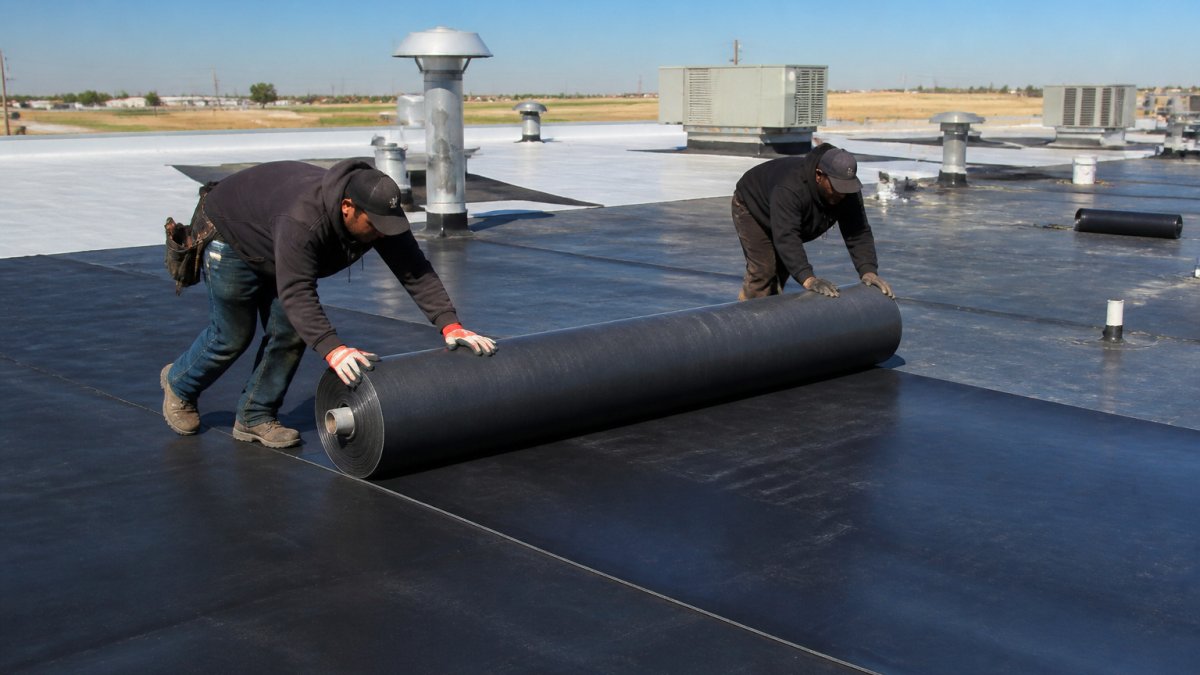
EPDM is a single-ply rubber membrane and one of the most widely used choices for low-slope roofs. It comes in large sheets, which means fewer seams than many alternatives.
Where EPDM works well:
- Flat roofs with limited foot traffic
- Projects where budget is the main constraint
- Buildings that need a proven, familiar membrane
Watch out: seams and flashings around penetrations are where EPDM most often fails, so installation quality matters more than the product itself.
2. TPO Roofing for Low-Slope Roofs
TPO (thermoplastic polyolefin) is a single-ply membrane often compared directly with EPDM and PVC. It is typically heat-welded at seams, which can produce strong, continuous joints when installed properly.
Where TPO works well:
- Buildings where a light-coloured, reflective surface is useful
- Roofs that benefit from welded seams
- Projects comparing single-ply options on performance and seam quality
Confirm the specific product and thickness with your contractor, since performance varies between manufacturers.
3. Modified Bitumen Roofing for Multi-Layer Protection
Modified bitumen is an asphalt-based system reinforced with polymers and typically built up in layers. It is a familiar option on low-slope roofs and is often considered when owners want a multi-layer system rather than a single membrane.
Installation methods vary. Torch-on and cold-process applications are both used, and the method affects both schedule and site safety.
4. Other Low-Slope Roof Membrane Options Compared
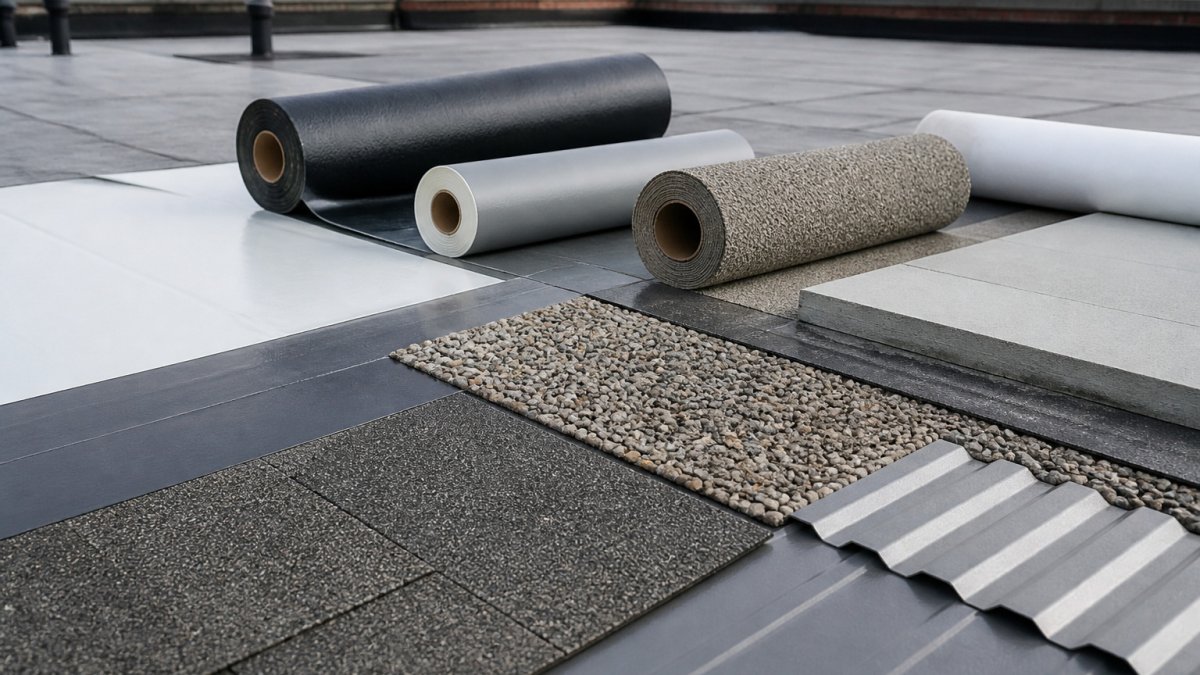
Beyond EPDM, TPO and modified bitumen, owners will also encounter PVC, built-up roofing (BUR), standing-seam metal and roll roofing. For a step-by-step look at how these installations are carried out, read our flat roof installation services guide. PVC is a single-ply membrane often compared with TPO and EPDM. Built-up roofing uses alternating layers of bitumen and reinforcement and is a long-established multi-ply category. Standing-seam metal suits some low-pitch applications, though suitability depends on the specific system and roof design. Roll roofing is a lower-cost option whose performance depends heavily on installation.
Asphalt shingles appear on some lists for mildly low-pitch roofs, but only when installed correctly, so they are not a general solution for flat roofs.
Side-by-Side Comparison and Lifecycle Cost Considerations
The table below summarises how the main options compare on the factors that actually drive long-term value, not just the sticker price. Use it as a starting point, then confirm details for your specific roof.
| Material | Type | Best For | Installation Notes | Key Trade-Off | Typical Service Life | Relative Installed Cost |
|---|---|---|---|---|---|---|
| EPDM | Single-ply rubber | Budget-conscious flat roofs | Large sheets, fewer seams | Seam and flashing quality matter | Often 15-25 years | Low |
| TPO | Single-ply thermoplastic | Reflective, welded-seam roofs | Heat-welded seams | Product-dependent performance | Often 15-25 years | Low to moderate |
| PVC | Single-ply thermoplastic | Chemical or grease exposure | Heat-welded seams | Usually a higher-cost membrane | Often 20+ years | Moderate to high |
| Modified bitumen | Polymer-modified asphalt | Multi-layer protection | Torch-on or cold-process | Heavier; method affects schedule | Often 15-20 years | Moderate |
| Built-up roofing | Multi-ply asphalt | Long-established multi-ply systems | Layered, labour-intensive | Heavier and slower to install | Often 15-25 years | Moderate to high |
| Standing-seam metal | Metal panel | Some low-pitch applications | Depends on system design | Suitability depends on the roof | Often 30+ years | High |
| Roll roofing | Mineral-surfaced roll | Lower-cost, simple applications | Installation-sensitive | Shorter service life | Often 10 years or less | Low |
Those service-life and cost bands are planning ranges, not quotes. Actual numbers depend on membrane thickness, attachment method, substrate, climate exposure, foot traffic and installation quality, and a quote for your specific roof is the only number that matters for budgeting.
How to compare lifecycle cost. The cheapest membrane is rarely the cheapest roof. A useful comparison adds four things over a 20-year horizon: the installed cost, expected maintenance and repair frequency, the likely timing of a full replacement, and the cost of disruption (tenant complaints, interior damage, emergency repairs). A low-cost membrane that needs seam repairs every few years can easily cost more over 20 years than a higher-priced system with better seams and stronger warranty support. Ask every contractor for the same scope, the same membrane thickness and the same warranty terms so the quotes are actually comparable.
Climate and exposure. Low-slope performance is heavily climate-dependent. In cold regions, freeze-thaw cycles stress seams and flashings, and snow load and ice damming put a premium on attachment and detailing. In hot, sunny regions, UV exposure ages membranes and makes reflective surfaces more valuable. In high-rainfall or wind-driven-rain areas, drainage capacity and seam integrity matter more than membrane colour. A material that performs well in one exposure can underperform in another, so match the system to your actual conditions rather than to a generic ranking.
Drainage and ponding prevention. On a low-slope roof, drainage is part of the roofing system, not an accessory. Confirm that drains, scuppers and overflows are correctly sized and kept clear, that the roof has positive slope to the drains, and that there are no low spots where water can stand. Ponding water is the most common reason a new membrane fails early, and no membrane choice compensates for poor drainage.
Compare quotes on the same scope, membrane thickness and warranty, then weigh installed cost against expected service life, repair frequency and drainage performance. The best low-slope roof is the one whose seams, flashings and drainage are detailed correctly for your climate and pitch, not simply the one with the lowest price per square foot.
Repairability and end-of-life. Single-ply membranes are generally straightforward to patch, which matters for buildings that cannot tolerate long disruptions. Modified bitumen and built-up systems can also be repaired, but matching layers and finishes takes more care. Metal is repairable but panel and finish matching can be a constraint. Ask your contractor how repairs are typically done on the system they are proposing, and what the end-of-life plan is, since disposal and recycling options vary by material and by local facility.
Booking a Low-Slope Roof Assessment With Iron Shield Roofing
If you are weighing these options for a warehouse, retail plaza, condo building or home, the fastest way to decide is an on-site assessment. You can review our low-slope roofing service page for Edmonton projects. If you need a full replacement after comparing membranes, our roof replacement services cover tear-off, disposal and a new code-compliant roof. For a free quote on a specific system, visit our site. If EPDM looks like the right fit, our EPDM roofing installation page explains the process from start to finish.
Frequently Asked Questions
What is the lowest roof pitch you can use shingles on?
Asphalt shingles are generally limited to mildly low-pitch roofs, and only when they are installed correctly with the manufacturer’s required underlayment and sealing. On very flat roofs, shingles can allow water to back up under the tabs and leak. For flat or near-flat roofs, membrane systems such as EPDM, TPO or modified bitumen are the more reliable choice. Check the shingle manufacturer’s minimum pitch rating before choosing this option.
What shingles are best for a low-slope roof?
Shingles are rarely the best choice for a true low-slope roof. If the roof pitch is only slightly low, a high-quality asphalt shingle with proper underlayment can work. For roofs with minimal slope, a membrane system is usually more durable. Iron Shield Roofing can assess your roof’s pitch and recommend a suitable system for your building in Edmonton.
Is a metal roof suitable for a low-slope roof?
Standing seam metal can be used on low-slope applications, but it requires careful detailing at seams, edges and penetrations to prevent water infiltration. Ponding water is the main concern, so the roof deck must be properly sloped and drained. Metal is well suited to freeze-thaw conditions and heavy snow loads when designed correctly. Pricing varies by project, so request a site-specific quote.
How does roof slope affect the choice of roofing material?
Roof slope determines how quickly water drains. Steeper roofs shed water with overlapping shingles or panels, while low-slope roofs rely on continuous membranes, tight seams and proper drainage to prevent ponding. Materials such as EPDM, TPO and modified bitumen are designed for these conditions. Matching the material to the slope and the local climate reduces leak risk and extends the roof’s service life.

