
Last Updated: November 4, 2026
Quick Summary
Roofing maintenance plans for property managers are scheduled programs that catch small roof problems before they become expensive failures. A planned program typically costs 1% to 3% of total roof replacement value per year, and structured inspections can reduce commercial roof repair costs by 25-40%.
- Schedule seasonal checks for drainage and weather exposure, plus annual full membrane and seam inspections.
- Budget maintenance as a recurring operating expense, separate from capital reserves for roof replacement.
- Documented inspection histories help insurance claims and can be required for warranty coverage.
- Record every checklist item with a date, location reference and photo to enable year-over-year comparison.
- Schedule the fall inspection before the first heavy snowfall, since freeze-thaw and snow load reveal hidden damage.
Table of Contents
- Why Roofing Maintenance Plans Matter for Property Managers
- What a Roofing Maintenance Plan Should Include
- Building a Commercial Roof Inspection Checklist
- Setting a Roof Maintenance Schedule for Property Managers
- Preventative Roof Maintenance Program Benefits and ROI
- Budgeting, Documentation and Software Integration
- Booking Your Roof Assessment With Iron Shield Roofing
- Frequently Asked Questions
Why Roofing Maintenance Plans Matter for Property Managers
Roofing maintenance plans for property managers are structured, scheduled programs that catch small roof problems before they become expensive failures. A planned program typically costs between 1% and 3% of the total roof replacement value per year, according to Upstate Roofing Pros, roof maintenance budgeting benchmarks for 2026.
The financial case is strong. Structured inspection programs can reduce commercial roof repair costs by 25-40%, as Oxmaint’s facility maintenance benchmarks, 2026 reports.
Insurance has become a second reason. Commercial carriers are increasingly asking for documented inspection histories before paying storm damage claims. Without records, a legitimate claim can become a dispute over whether the damage was sudden or simply neglected.
What a Roofing Maintenance Plan Should Include
A complete plan covers more than a periodic walk across the membrane. Industry guidance for 2026 suggests scheduling work across three horizons: seasonal checks, annual inspections, and multi-year reviews of the roof’s overall condition, as outlined by Roof Masters & Exteriors’ property manager guidance, 2026. Our commercial roof maintenance tips cover the detailed practices behind each of these horizons.
Seasonal work focuses on drainage and weather exposure. Clear debris from drains and scuppers, check flashing around penetrations, and look for ponding water after storms. Annual work adds a full membrane inspection, seam and caulk terminations, pipe seal checks and a review of any warranty conditions that depend on documented maintenance.
Multi-year reviews support capital planning. A roof condition assessment establishes a baseline, shows remaining service life, and gives you a defensible basis for replacement budgets.
Building a Commercial Roof Inspection Checklist
A usable checklist is specific enough that two different inspectors would record the same conditions. Start with the membrane: look for blisters, cracks, punctures, granule loss on modified bitumen, and any areas that feel soft underfoot. Then move to seams, edges and terminations, where most leaks begin.
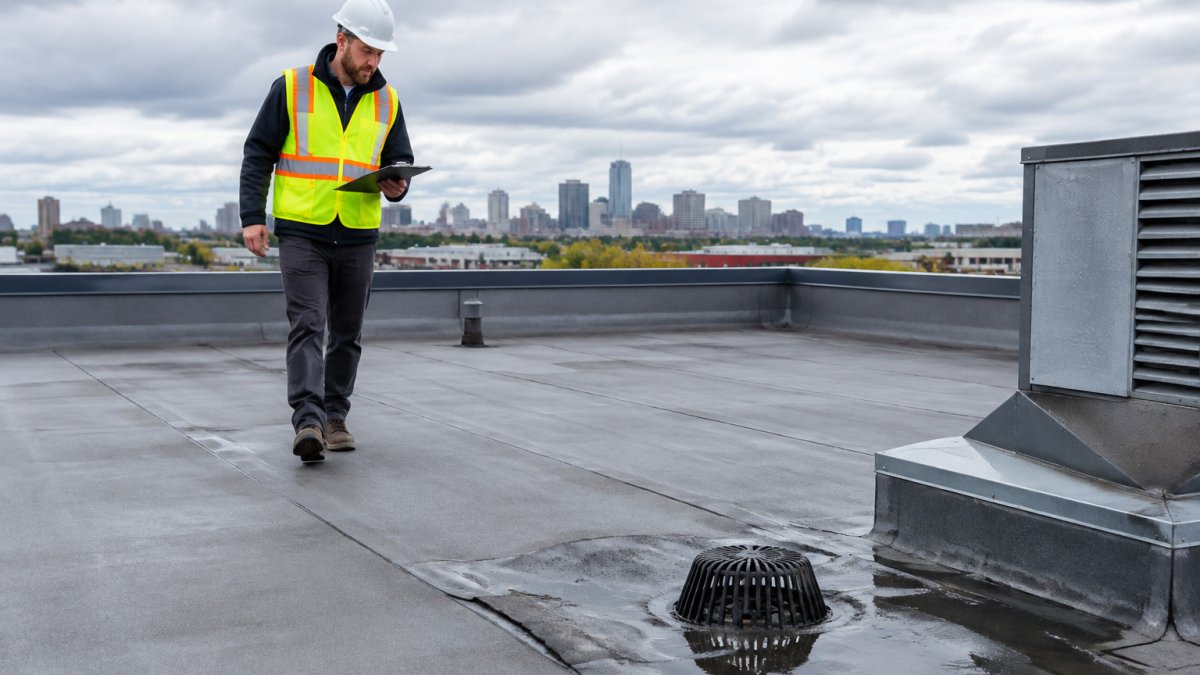
Work through the roof systematically:
- Drainage: drains, scuppers and gutters clear, with no standing water 48 hours after rain
- Flashing: wall, curb and penetration flashing intact and sealed
- Seams and laps: no lifting, splitting or open edges
- Caulk and sealant terminations: no cracking or shrinkage at pipes and edges
Record each item with a date, a location reference and a photo. Consistent records are what make the checklist useful over time, because you can compare this year’s condition with last year’s.
Iron Shield Roofing has experience with the freeze-thaw and snow-load conditions common in Alberta, which place considerable stress on seams and fasteners.
Setting a Roof Maintenance Schedule for Property Managers
A maintenance schedule turns the checklist into a calendar.
Assign ownership to each task. The property manager approves the budget and receives the reports. A qualified roofing contractor performs the technical inspection. Maintenance staff handle drain clearing and debris removal between visits.
Build the schedule into your property management software so reminders, vendor bookings and inspection reports sit in one place.
Preventative Roof Maintenance Program Benefits and ROI
The return on a maintenance program comes from avoided costs, extended roof life and deferred capital replacement. Most property managers already believe this intuitively; the harder job is proving it in a budget meeting. The framework below is built for that conversation, not for a brochure.
A four-part ROI model you can defend
Build the case in four lines, each of which a stakeholder can challenge and you can support with records:
- Program cost. Annual inspection fees, drain clearing, minor repairs and report administration. Express this as an annual figure per building and as a percentage of current roof replacement value. A common planning range is 1% to 3% of replacement value per year, which gives you a sanity check against quoted fees.
- Avoided reactive repairs. Use your own work-order history to estimate how many emergency repairs the program prevents and at what average cost. If you have no history, start with the documented benchmark that structured inspection programs can reduce commercial roof repair costs by 25-40%, as Oxmaint’s facility maintenance benchmarks, 2026 reports, and apply it to your trailing three-year repair spend.
- Avoided interior and consequential damage. Add the cost of water-damaged ceilings, insulation, tenant improvements, displaced rent and emergency after-hours labor. These are the costs that turn a small leak into a budget event, and they are the easiest line for an owner to underweight.
- Service-life extension. Estimate the additional years of service the program buys and divide the replacement cost by the extended life. A roof that reaches its expected service life instead of being replaced early converts a capital expense into deferred capital, which is the number finance stakeholders care about most.
Worked example with placeholder figures
Replace these numbers with your own, but keep the structure. A program costing $4,000 per year prevents one $15,000 membrane repair and one $8,000 interior water damage claim, producing $19,000 in avoided costs and a net benefit of $15,000 in that year.
Watch out: do not present avoided costs as guaranteed savings. Frame them as expected value based on your own history, and show the assumptions so a skeptical owner can test them.
Liability, insurance and warranty protection
Documented maintenance protects you in three ways. First, it supports insurance claims, since carriers increasingly require inspection histories before paying out. Second, it reduces liability exposure when water leaks injure tenants or damage property, because you can show reasonable care. Third, many roofing warranties depend on the owner performing and recording required maintenance. Check your warranty terms, because a missed inspection can void coverage you have already paid for.
Connecting maintenance to sustainability and energy performance
Regular maintenance also supports energy and certification goals. Clean drainage and intact insulation reduce ponding and heat loss, and documented maintenance records are the kind of evidence green building certification programs expect when verifying ongoing performance. If your portfolio pursues certification or energy reporting, fold roof inspection records into that file rather than keeping them separate.
The framework below summarises the key figures and checks a property manager can use when building the case for a maintenance program.
| Item | Value | Note |
|---|---|---|
| Annual program cost | 1%-3% of replacement value | Planning range per year |
| Commercial repair cost reduction | 25-40% | Structured inspection programs |
| Worked example program cost | $4,000 per year | Placeholder figure |
| Worked example net benefit | $15,000 in that year | Avoided costs of $19,000 |
| Worked example deferred capital | $133,000 | Three years of extended life on $400,000 roof |
Budgeting, Documentation and Software Integration
Budget maintenance as a recurring operating expense rather than an emergency fund. Keep a separate line for roof maintenance, and reserve capital funds for replacement based on the condition assessment. This separation makes the case for maintenance easier to defend at budget review, and it prevents roof work from competing with unrelated operating costs for the same dollars.
Documentation that follows the roof for its whole life
Store inspection reports, photos, invoices and warranty paperwork in a single digital record for each building. The record should answer four questions at any time: what was inspected, when, by whom, and what was done about it. When a claim, a tenant dispute or a sale due-diligence request arrives, that record is the difference between a quick resolution and a prolonged argument.
Integrating roof maintenance into property management software
Most property managers already run a platform for work orders, vendors and budgets. The goal is to make roof maintenance a tracked work type inside that system rather than a separate spreadsheet. A practical integration looks like this:
- Create a roof asset record per building. Note the membrane type, installation date, warranty terms and replacement value. This becomes the anchor for every inspection and repair.
- Set recurring work orders. Schedule spring and fall inspections as recurring tasks with assigned vendors, so reminders fire automatically and nothing depends on memory.
- Attach reports and photos to the work order. When an inspector submits findings, attach the report and photos to the same record so the history stays with the asset.
- Tag recurring problem areas. If the same drain or seam appears in three consecutive reports, tag it so it surfaces in budget discussions and vendor reviews.
Watch out: platform integrations vary widely, and some property management systems handle recurring vendor tasks better than others. Confirm with your administrator which fields and reports are actually available before promising a stakeholder a dashboard.
Making the record useful at budget time
A complete record lets you show a buyer, lender or owner a documented maintenance history, and it lets you defend a maintenance line item with evidence rather than assertion. Review the record annually alongside the condition assessment, and update the replacement value and remaining service life so the budget reflects current conditions rather than the assumptions made when the roof was installed.
Booking Your Roof Assessment With Iron Shield Roofing
If you manage a commercial, industrial or multi-residential roof and do not yet have a documented maintenance plan, the fastest starting point is a condition assessment. Our metal roof inspections in Calgary and flat roof maintenance in Calgary services are structured around the checklist and schedule described above. For a full baseline report, you can also review our roof condition assessments.
For a customized plan and quote, contact Iron Shield Roofing. Get a free quote! You can also request a roof inspection in Calgary directly through our booking page.
Frequently Asked Questions
What should be included in a commercial roof maintenance plan?
A solid commercial roof maintenance plan covers scheduled inspections, drainage clearing, debris removal, membrane and flashing checks, caulk and pipe seal repairs, and documented minor repairs. Plans should also set out emergency leak response protocols and a capital expenditure outlook for the roof’s remaining service life. Written service level agreements with your roofing contractor make expectations clear. Ask whether the contractor provides records you can use for warranty compliance and insurance claims, since those records are often what decides a storm damage claim.
How often should a commercial roof be inspected in Alberta?
Most property managers plan roof inspections on three horizons: seasonal checks, an annual comprehensive inspection, and a multi-year condition assessment. Seasonal checks in spring and fall catch winter damage and drainage problems before they grow. Alberta’s freeze-thaw cycles and heavy snow loads make post-winter inspections especially important. A full roof condition assessment every few years helps with capital expenditure planning. Exact frequency depends on roof age, membrane type and building use, so confirm the interval with your contractor.
What does a preventative roof maintenance program cost?
Actual pricing depends on roof size, membrane type, access and the scope of work. Request a written quote from Iron Shield Roofing for current pricing based on your building.
How do I document roof maintenance for insurance purposes?
Keep a dated log of every inspection, repair, cleaning and warranty-related visit, along with photos, contractor reports and invoices. Consistent records matter when insurers review storm damage claims. Store them in your property management software or a shared asset file so they can be retrieved quickly after an incident.
Why does preventative maintenance cost less than reactive repairs?
Small problems like a failed pipe seal or clogged drain are cheap to fix early but can cause interior water damage, tenant disruption and membrane failure if ignored. Preventative work also extends roof service life, which delays capital replacement.
Can roof maintenance be scheduled around occupied tenants?
Yes. Experienced crews plan access around tenant schedules, noise-sensitive hours and active operations. Ask your contractor how they coordinate with occupants, how they secure work areas, and whether they provide advance notice. Iron Shield Roofing crews are trained in tenant coordination, and you can discuss your building’s schedule when requesting a quote.
Do small industrial facilities need a formal roofing maintenance plan?
Yes. Even a small industrial shop benefits from a documented plan, because roof failure can halt production and damage stored equipment. A simpler plan with one or two inspections a year, drainage checks after storms and a written repair history is often enough. Contact Iron Shield Roofing to discuss a scope that fits a smaller building.

