
Last Updated: November 19, 2026
Quick Summary
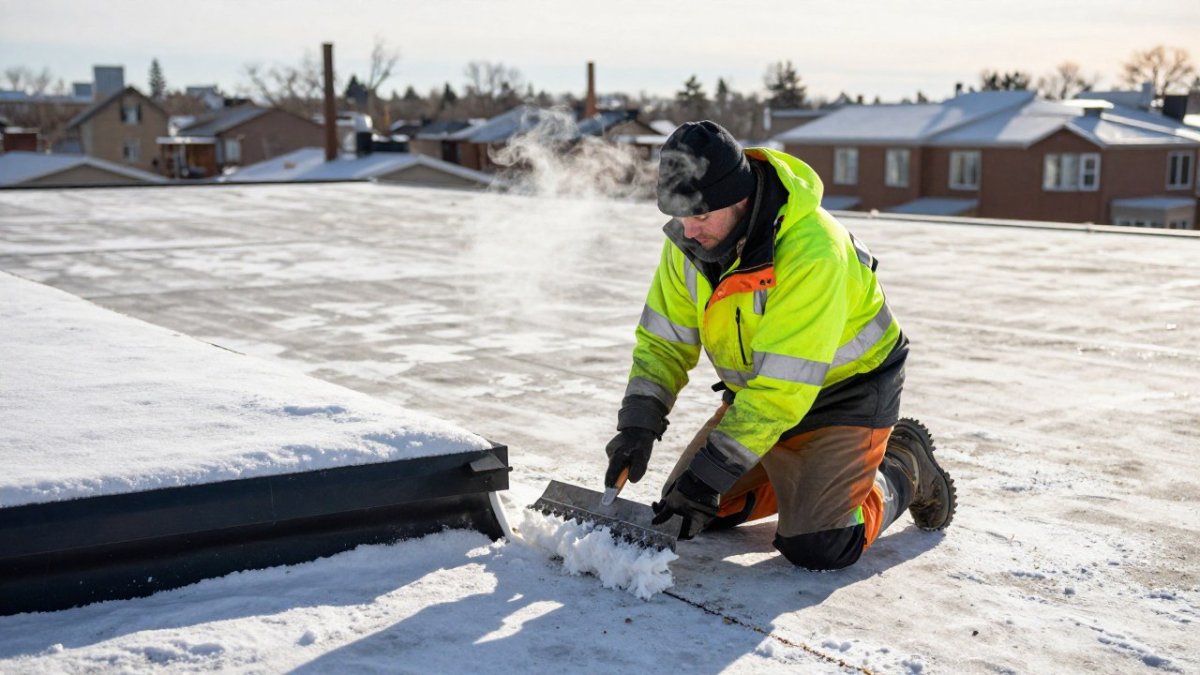
Why do flat roofs leak in winter? Snow sits on the membrane instead of sliding off, and meltwater cannot drain when drains and scuppers freeze. Repeated freeze-thaw cycles then widen small splits, lift flashing and push water into the building.
- Snow lingers on flat roofs, holding moisture against the membrane.
- Leaves in drain bowls can form ice plugs that block drainage.
- Clear drains and scuppers before the first hard freeze.
- Do not walk on a snow-covered or icy flat roof to inspect it.
- Schedule a roof inspection in fall, before the first hard freeze.
Table of Contents
- How Winter Conditions Put Flat Roofs Under Stress
- Flat Roof Leak Causes That Show Up in Winter
- Flat Roof Drainage Problems That Cause Winter Leaks
- Step-by-Step: Tracing the Source of a Winter Roof Leak
- Emergency Steps and Winter Roof Leak Repair Limits
- Flat Roof Winter Maintenance to Prevent Repeat Leaks
- Book a Winter Roof Inspection With Iron Shield Roofing
- Frequently Asked Questions
How Winter Conditions Put Flat Roofs Under Stress
Winter is hard on a flat roof, and most leaks start with stress rather than a single failure, which is why many owners ask why do flat roofs leak in winter.
The main stress comes from temperature swings. A roof can thaw in the afternoon and freeze again overnight, and that repeated movement is hard on any membrane. Knowing this makes it easier to spot early warning signs before water reaches the ceiling.
Freeze-thaw cycles and membrane movement
Freeze-thaw cycles are the repeated process of water melting, refreezing and expanding. When water gets into a small crack or seam, it swells as it freezes and pushes the opening wider.
Membranes also expand and contract with temperature. Cold makes them stiffer and more brittle, while warm spells let them relax. Over many seasons, this movement can split seams, lift flashing and open small punctures. Water then has a route into the building.
- Small cracks widen with each freeze.
- Seams and flashing lift as the membrane contracts.
- Ice wedges into gaps that were fine in summer.
Flat Roof Leak Causes That Show Up in Winter
Winter leaks usually have one of a few causes. The leak you see inside is often far from the spot where water first got in, so it helps to know what to look for on the roof itself.
Snow loads, ice and meltwater
Snow sitting on a flat roof is a bigger problem than snow on a pitched roof, because nothing carries it off. A heavy layer holds moisture against the membrane and can push meltwater toward low spots.
Meltwater is the common link in most winter leaks. It needs somewhere to go, and if it cannot drain, it finds the weakest point in the roof. This is the main answer to why do flat roofs leak in winter.
Membrane splits, blisters and failed flashing
Membrane splits and blisters are common after a few cold seasons. For repair, restoration and replacement options for a tar and gravel system, see tar and gravel roof repair, restoration and replacement. A split opens a path for water, while a blister traps moisture underneath until it breaks through. Flashing, the metal or membrane strips that seal edges and penetrations, is a frequent failure point. Where flashing lifts or pulls away from a wall or vent, snowmelt can run straight beneath the roofing.
- Look for splits along seams and around roof penetrations.
- Check blisters for soft spots or loose membrane.
- Inspect flashing at parapets, vents and roof edges.
Flat Roof Drainage Problems That Cause Winter Leaks
Drainage is the most common reason a flat roof leaks in winter, and the mechanism is straightforward: meltwater needs a path off the roof, and when that path is blocked or the slope is wrong, water sits, refreezes, and works its way into the membrane. A roof that drains well can handle a heavy snow load; one blocked drain can turn a light snowfall into a ceiling stain.
How drains and scuppers freeze
Roof drains and scuppers are the primary outlets on most low-slope roofs. In winter, they fail in a predictable sequence. Leaves and debris collect in the drain bowl through fall, then snowmelt refreezes around that debris and forms an ice plug.
Downspouts matter too. If a downspout freezes solid, the drain above it cannot discharge, and water backs up into the drain bowl and onto the roof surface.
- Ice plugs form around debris in drain bowls and scuppers.
- Frozen downspouts back water up onto the roof surface.
- Meltwater refreezes overnight and expands the plug.
Ponding water and slope
Ponding water is standing water that remains on a roof for more than a day or two after snowmelt or rain. It is a warning sign, not a cosmetic issue. Flat roofs are not perfectly flat, they are designed with a slight slope toward drains or scuppers, and any area that holds water indicates either a low spot in the deck or a drainage path that is not working.
You can assess ponding without climbing onto the roof. From inside the building, look for ceiling stains that reappear after snowmelt in the same location.
Watch out: Do not walk on a snow-covered or icy flat roof to check drains yourself. A fall from a low-slope roof is a serious injury risk, and the membrane is often more slippery than it looks.
What to check before and after snow
Before the first hard freeze, clear leaves and debris from drain bowls, scuppers, and downspouts. After a heavy snow or a mid-winter thaw, check from the ground for ice dams forming at the roof edge and for downspouts that are not discharging.
Keeping drains clear helps meltwater leave the roof before it refreezes. Keeping drains clear is a simple step that helps prevent many winter leaks.
The table below sums up the most common drainage faults, what causes them, and how to fix them.
| Problem | Cause | Fix |
|---|---|---|
| Ice plug at drain | Debris in drain bowl, meltwater refreezes | Clear debris before first freeze |
| Frozen downspout | Ice blocks the downspout | Call a roofer to clear it safely |
| Ponding water | Low spot or drainage path not working | Find the low spot and fix the drainage path |
| Ice bridging scupper | Ice seals the scupper opening | Have a roofer clear it, do not chip it |
| Ceiling stain after snowmelt | Water collecting in a low spot | Inspect the roof above the stain |
Step-by-Step: Tracing the Source of a Winter Roof Leak
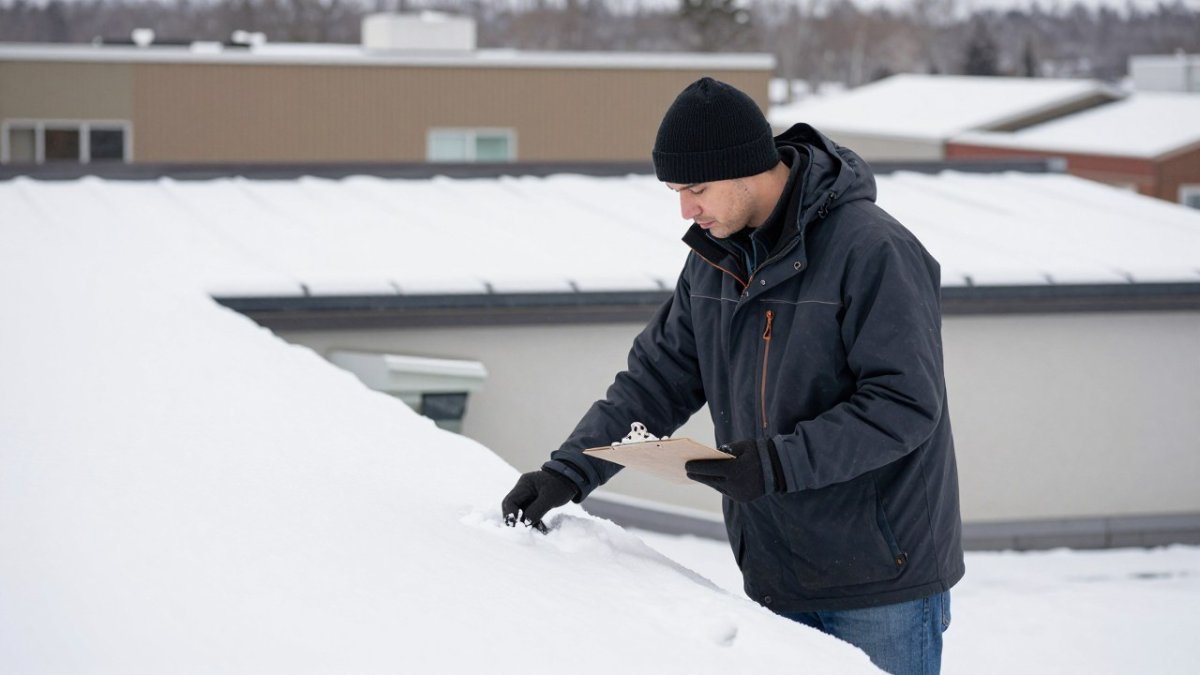
When water shows up inside a building, the source is not always obvious. Follow these steps to narrow it down before calling for repairs.
- Note when the leak appears. Does it show up during snowmelt, a cold snap, or heavy rain? Timing points to the cause.
- Mark the interior spot. Find the wet area on the ceiling or wall and note its position relative to a known landmark.
- Look at the roof above the spot. Check the membrane, seams, drains and flashing. Look for splits, blisters, ponding or debris.
- Clear the drains safely. Remove snow and ice from around drains only if it is safe to do so.
- Document what you see. Photos and dates help a roofer trace the leak and support any insurance claim.
Ruling out condensation and plumbing leaks
Not every winter leak comes from the roof. Condensation forms when warm, moist indoor air meets a cold surface, and it can look just like a roof leak. Plumbing leaks can also drip into a ceiling space during cold weather. A common approach is to check whether the water appears only during snowmelt or heavy rain (roof leak) or on cold, dry days as well (condensation or plumbing).
Emergency Steps and Winter Roof Leak Repair Limits
If water is coming through the ceiling, protect people and property first. Move furniture and electronics away from the drip, place buckets or tarps under the leak, and keep occupants clear of the area below. Keeping these details can help trace the source and limit further damage, while preventing water damage starts with addressing the conditions that let winter leaks develop.
A safe emergency response sequence
- Contain the water. Place buckets under active drips and lay tarps or plastic sheeting over belongings. If the ceiling is bulging, do not puncture it, call a professional.
- Protect people. Keep occupants out of the affected area. If water is near electrical panels, fixtures, or wiring, shut off power to that section at the breaker.
- Document everything. Photograph the leak, the damaged area, and any belongings affected. Note the date, time, and weather conditions when the leak appeared.
- Avoid roof access. Do not climb onto a snow-covered or icy roof to look for the source. Most winter roof injuries happen during amateur inspections.
- Call for help. Contact a roofer for an assessment and temporary measures, and your insurer if damage is significant.
Why cold-weather repairs have limits
Temporary fixes can slow water down, but they have real limits in winter. Most roofing adhesives, sealants, and membrane bonding products are formulated to work within a specific temperature range.
Different membrane materials behave differently in cold. Modified bitumen becomes stiffer and more prone to cracking when worked in low temperatures. EPDM and TPO membranes contract and become less flexible, which makes seaming and patching harder.
Watch out: Do not apply a permanent patch or adhesive in freezing temperatures and expect it to last.
When to wait for warmer weather
Some repairs should wait. If the leak is contained and the temporary measure is holding, a permanent repair in spring is often the better choice than a cold-weather patch that may fail. If water is actively damaging the interior, a roofer can apply a temporary seal or tarp to limit damage until conditions improve. The key is to stop the water from spreading and to document the damage, not to force a permanent repair in conditions that will not support it.
Flat Roof Winter Maintenance to Prevent Repeat Leaks
Routine maintenance is the best defence against winter leaks. Schedule an inspection in the fall, before the first hard freeze, and check the roof again after major storms.
For tar and gravel roofs, watch for loose gravel and cracks in the surface, since both let water reach the layers below. For a closer look at routine winter care, see our flat roof maintenance tips for Edmonton winters.
Keep records of every inspection and repair. These notes help you spot repeat problems and show a pattern to your roofer.
Book a Winter Roof Inspection With Iron Shield Roofing
A winter leak is easier to fix before the snow sets in. If your flat roof is showing signs of trouble, or you have had leaks return after a previous fix, contact Iron Shield Roofing for an inspection. Contact Iron Shield Roofing for an inspection and a quote. For Edmonton flat roofing installation and repair, visit our flat roof installations in Edmonton page.
For emergency options when water is already inside, see our guide to emergency flat roof repair.
Frequently Asked Questions
Why do flat roofs leak in winter?
Flat roofs leak in winter mainly because snow and ice hold meltwater on the roof surface, and freeze-thaw cycles make the membrane expand, contract and split at seams, flashings and penetrations. When drains or scuppers are blocked by ice, meltwater pools and seeps into gaps that were sealed in warmer months. Winter leaks are rarely normal. They usually point to a drainage problem, a membrane defect or failed flashing that a roofing professional should inspect and repair.
Is it normal for a flat roof to leak every winter?
No. A flat roof that leaks every winter has an underlying problem, such as clogged drains, undersized scuppers, poor slope, damaged membrane or inadequate insulation and vapour control. Repeated leaks in the same spot usually mean a temporary patch was applied instead of the cause being corrected. An inspection can identify whether the issue is drainage, membrane condition or flashing so that a lasting repair can be planned.
Can snow and ice cause a flat roof to leak?
Yes. Snow that stays on a flat roof melts during warm spells, and the water needs to reach drains or scuppers to leave the roof. If the drains are blocked by ice or debris, the water sits on the membrane and can find its way through seams, punctures or failed flashing. Heavy snow loads can also stress the structure and membrane. Removing snow carefully and keeping drains clear reduces this risk.
What should I do first if my flat roof leaks in winter?
First, make sure occupants are safe. Move people and valuables away from the leak, switch off electrical fixtures in the affected area if water is reaching them, and keep clear of any ceiling that is sagging. Place buckets or tarps to catch water and note the time and location of the leak. Do not climb onto an icy roof to investigate. Contact a roofing professional to inspect the roof and make a temporary repair if needed.

