Last Updated: November 21, 2026
Quick Summary
Metal roofing benefits for Edmonton homes come down to three things: it sheds snow instead of holding it, it survives freeze-thaw cycles without absorbing water, and it lasts long enough that the higher upfront cost spreads thin over decades. A quality aluminum metal roof may have a 50-to-75-year lifespan, a very different ownership math than asphalt.
- Metal resists wind uplift better than shingles and does not rot or support mold.
- Snow releases in slides on metal, so snow retention is needed above doorways, walkways, and gas meters.
- Metal is a strong fit on simple gable and hip roofs with straightforward flashing.
- Inspect fasteners, seams, flashing, and snow retention hardware in late fall and spring.
- Energy savings from metal roofing are real but often oversold, so treat them as a bonus.
Table of Contents
- Why Metal Roofing Suits Edmonton Homes
- Metal Roof Pros and Cons for Alberta Weather
- How Metal Roof Snow Performance Works Through an Edmonton Winter
- Metal Roofing vs Asphalt Shingles: Lifespan, Value, and Trade-offs
- Metal Roof Maintenance Through Freeze-Thaw Cycles
- Energy Efficiency, Curb Appeal, and Home Value
- Planning Your Metal Roof Installation in Edmonton
- Frequently Asked Questions
Why Metal Roofing Suits Edmonton Homes
Metal roofing is a roof system made from steel, aluminum, or coated metal panels and shingles, and it earns its place in Edmonton because it handles the two things this climate does worst to a roof: water that refreezes and snow that sits. At Iron Shield Roofing, we install metal, flat, and sloped systems in Edmonton, and the metal calls we get often start with the same question: is it actually worth it here?
Here is the short answer. Metal roofing benefits for Edmonton homes come down to three things: it sheds snow instead of holding it, it survives freeze-thaw cycles without absorbing water, and it lasts long enough that the higher upfront cost spreads thin over decades. A quality aluminum metal roof may have a 50-to-75-year lifespan, according to Interlock Roofing’s metal roof analysis, which is a very different ownership math than asphalt.
Below, we walk through the pros and cons honestly, what snow really does on a metal roof through an Edmonton winter, and how to decide whether your house is a good fit.
Metal Roof Pros and Cons for Alberta Weather
The pros are real and they are climate-specific. Metal resists wind uplift better than shingles, it does not rot or support mold when water gets behind it, and it reflects solar heat rather than soaking it up. McElroy Metal’s guidance on reflective roofing explains how that reflection reduces the heat a roof surface absorbs, which matters more every summer.
The cons are equally real, and most guides skip them:
- Upfront cost. Metal costs more to install than asphalt. That gap is the whole debate.
- Noise and rain. Without proper sheathing and underlayment, rain and hail are louder on metal. Build the assembly right and it is a non-issue.
- Snow shedding has a downside. Snow releases in slides, so anything below the eaves, including walkways and downspouts, needs planning.
- Denting. Light-gauge panels can dent under heavy hail. Panel thickness and finish quality decide how well a roof holds up.
- Not every roof shape suits it. Complex hips, valleys, and tight dormers raise labor and waste.
U.S. News’ overview of metal roofing trade-offs makes the same point: metal is not an unconditional choice for every home. It is a strong choice when the assembly and the detailing are right.
How Metal Roof Snow Performance Works Through an Edmonton Winter
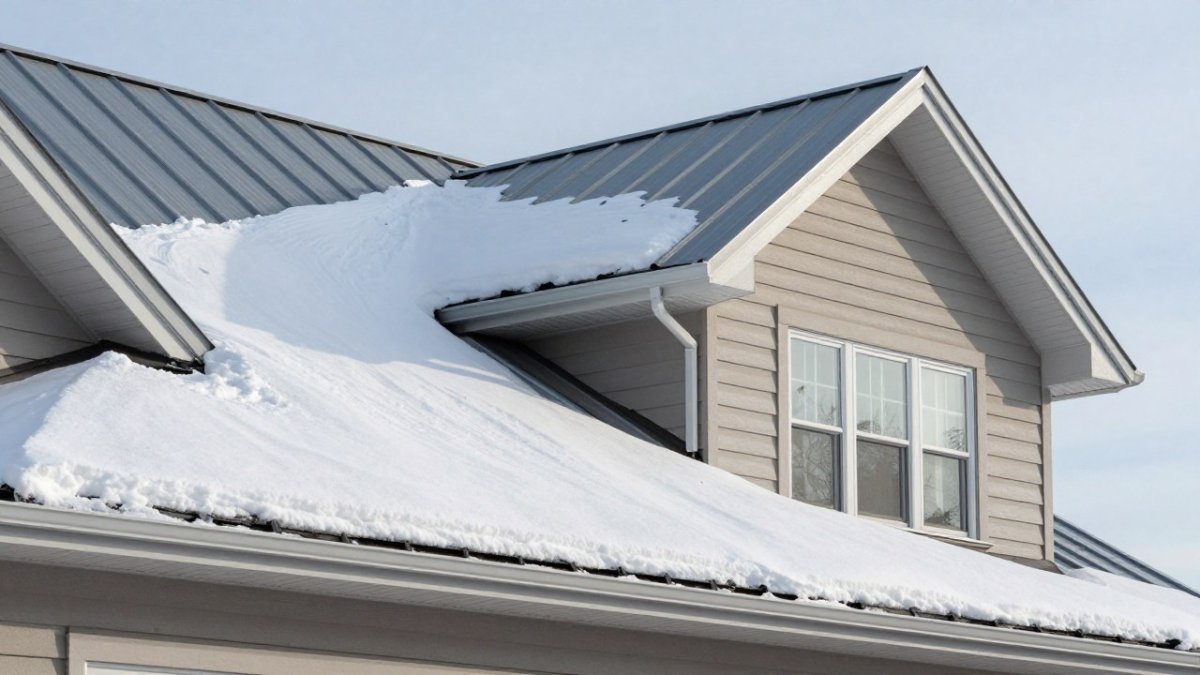
Metal roof snow performance generally depends on a smooth, low-friction surface. Snow accumulates, then can release in slides when sun and building heat loosen the bond.
That behavior is the biggest practical difference from asphalt in an Edmonton winter. Shingles grip snow. The granules and the rough surface hold it, and repeated melt-and-refreeze at the eave is what builds ice dams. A slippery metal surface gives meltwater a clear path down and off.
Two details make or break it. First, snow retention above doorways, walkways, and gas meters, so a slide does not land on someone. Second, attic ventilation and insulation, because a warm roof deck causes the melt-refreeze cycle that creates ice in the first place. Get both right and snow management becomes predictable.
Metal Roofing vs Asphalt Shingles: Lifespan, Value, and Trade-offs
The metal roofing versus asphalt shingles comparison usually gets framed as cost, and that framing is incomplete. It is a lifecycle question, and in Edmonton the lifecycle is shaped by freeze-thaw, snow load, and hail. Here is how the two systems actually differ when you own the roof for twenty years rather than two.
| Factor | Metal Roofing | Asphalt Shingles |
|---|---|---|
| Typical lifespan | Decades longer; quality aluminum systems may reach 50-75 years | Shorter service life, replaced more often |
| Upfront cost | Higher, driven by material, panel profile, and detailing complexity | Lower, driven by shingle grade and tear-off |
| Snow and ice behavior | Sheds snow; less ice damming when ventilation is correct | Holds snow; prone to ice dams at eaves |
| Maintenance | Minimal, occasional inspection | More frequent repair and replacement |
| Wind and hail | Strong wind resistance; hail performance varies by gauge and finish | Moderate; granules wear and seal strips fail |
| Resale | Recognized durable asset | Standard expectation |
Asphalt usually costs less on day one, while metal often compares more favourably over a longer ownership period. The mechanism is simple: asphalt is a sacrificial surface that wears down and gets replaced, while metal is a long-service assembly that you inspect and maintain. If you plan to stay in the house, the lifecycle cost of metal often comes out ahead because you are buying one roof instead of two or three.
What the table cannot show is where the money actually goes. On a metal roof, the cost drivers are panel gauge and profile, the underlayment and ventilation assembly, flashing and snow retention detailing, and the complexity of your roof shape. On asphalt, the drivers are shingle grade, tear-off and disposal, and how much deck repair is needed once the old roof is off. A like-for-like comparison has to include the second and third asphalt replacement you avoid, not just the first invoice.
Suitability matters too. Metal is a strong fit on simple gable and hip roofs with good access and straightforward flashing. It is a weaker fit on complex roofs with many valleys, dormers, and tight penetrations, where labor and waste rise and detailing risk increases. Asphalt remains a reasonable choice on a roof you will not own long enough to see the lifecycle crossover.
Either way, know what the paperwork actually covers. Our guide to roofing warranties for Alberta climates walks through what is and is not covered when freeze-thaw is the cause of a claim, and why material, paint, and workmanship warranties are three different things.
Metal Roof Maintenance Through Freeze-Thaw Cycles
Metal roof maintenance in Edmonton is mostly inspection, not repair. Freeze-thaw cycles are the reason. Water works into seams, around fasteners, and behind flashing, freezes, expands, and repeats. Metal itself handles that far better than asphalt, but the details around it still need checking.
What actually needs attention:
- Fasteners and washers. Check for backed-out screws and perished seals, especially after a wind event.
- Seams and flashing. Look at valleys, chimneys, and penetrations, where most leaks start.
- Snow retention hardware. Confirm brackets are secure before the first heavy snowfall, not after.
- Debris in valleys. Leaves and grit trap moisture against the panel.
- Drainage paths. Confirm water still exits where it should.
A common mistake is treating a metal roof as maintenance-free. It is low-maintenance, not zero-maintenance. One inspection in late fall and one in spring catches nearly everything before it becomes a repair. If you would rather hand that schedule to a crew, our metal roof maintenance service in Edmonton covers exactly this routine.
Energy Efficiency, Curb Appeal, and Home Value
Energy savings from metal roofing are real but often oversold. Oak Ridge National Laboratory’s study of metal roof energy performance found that tested roofs showed potential for substantial energy savings compared with an asphalt-shingle control, though the research does not quantify a number for every home. Treat savings as a bonus, not the reason to buy.
Curb appeal is the underrated factor. Metal shingles now mimic cedar shake, slate, and tile closely enough that most neighbors cannot tell from the street. That matters at resale, where a durable roof reads as a maintained home rather than a deferred cost.
If style is driving your decision, our Vicwest metal shingles in Edmonton page shows the actual profiles and colors available, including shake, slate, and wave styles. For the fuller case, our 10 reasons to choose a metal roof in Edmonton covers the climate argument in detail.
Planning Your Metal Roof Installation in Edmonton
Installation is where metal roofs succeed or fail, and Edmonton adds its own constraints. Permits, inspection sequencing, and the short window between freeze-up and spring all shape the schedule.
Start with the permit path. A roofing permit is typically required when you are changing the roof covering or the structure, and the rules are set by the local authority having jurisdiction. Confirm in writing who pulls the permit, who books the inspection, and what the inspection sequence looks like, because a metal roof often needs sheathing and underlayment inspected before panels go on.
Next, settle the assembly. Panel or shingle, underlayment, ventilation, and snow retention should be specified together, not piecemeal. A metal roof over an unventilated or under-insulated attic will still build ice at the eaves, and no panel profile fixes that.
Then lock the schedule. Metal installation in Edmonton is weather-sensitive: freeze-up closes the window for sealants and some detailing, and spring thaw can expose deck issues that were hidden. Get a start date, a weather contingency, and a material lead time in writing. Panel delivery is often the long pole, and a roof cannot be closed in until it arrives.
What to settle before you sign:
- Confirm the assembly. Panel or shingle, underlayment, and ventilation specified together, not piecemeal.
- Check the permit path. Confirm who pulls the permit and who handles inspection.
- Ask about snow retention. Get the layout in writing, above every doorway and walkway.
- Verify the warranty terms. Read what void conditions apply, especially around installation.
- Lock the schedule. Get a start date and a weather contingency in writing.
Watch out: hiring on panel price alone can lead to problems at the flashing. Detailing and the permit-to-inspection sequence matter as much as the material.
When you are ready to move from weighing options to a real number, our metal roof installation team in Edmonton can quote your roof and walk the assembly with you.
The decision comes down to how long you plan to own the home and how much you value never thinking about the roof again. Iron Shield Roofing installs metal, flat, and sloped roofing engineered for Alberta’s freeze-thaw cycles and snow loads, with crews trained to work cleanly around occupied homes and clear communication from quote to final inspection.
Frequently Asked Questions
Is metal roofing a good choice for Edmonton homes?
It can be, particularly where longevity and winter performance matter. Metal roofing is a roofing material that handles heavy snow, wind, hail, and temperature fluctuations well, and metal roofs are generally long-lived. The trade-offs are a higher upfront cost than asphalt shingles and the need for an installer experienced with local conditions. A contractor who works in Edmonton roofing year-round can confirm whether your roof structure and slope suit metal.
How does a metal roof perform in heavy snow?
Metal roof snow performance depends on the profile, the roof pitch, and how the surface is finished. A smooth metal surface lets snow shed rather than sit, which reduces sustained snow load and limits the freeze-thaw damage that shortens the life of other roofing materials. Shedding snow needs somewhere safe to land, so keep walkways, downspouts, and entries clear.
Can metal roofing withstand Edmonton’s wind and hail?
Metal roofing is widely chosen for wind and hail resistance, . Actual performance depends on the gauge, the fastening method, and the quality of installation, not the material alone. Ask your contractor for the manufacturer’s wind and impact ratings for the specific panel or shingle profile, and confirm the installation follows those requirements. Poorly fastened metal will not deliver the wind resistance the product is capable of.
How does metal roofing compare with asphalt shingles on cost and value?
Metal roofing costs more upfront than asphalt shingles, and that gap is the main reason homeowners hesitate. The long-term value case rests on lifespan: metal roofs are generally long-lived, while asphalt shingles are replaced far more often. Over decades, fewer replacements and lower repair costs can offset the initial difference. Pricing for your roof depends on size, profile, and complexity, so request a quote rather than relying on general figures.

