
Table of Contents
- What Edmonton Property Owners Should Look for in Commercial Roofing Companies
- Commercial Roofing Contractor Checklist: 12 Questions to Ask Before You Hire
- Commercial Roof Inspection: What Happens and How Often
- Commercial Flat Roof Replacement: Systems, Timelines, and Disruption Control
- Commercial Roofing Cost: What Drives Your Quote
- Preventive Maintenance and Lifecycle Planning for Edmonton Buildings
- Frequently Asked Questions
Last Updated: October 12, 2026
What Edmonton Property Owners Should Look for in Commercial Roofing Companies
Finding dependable commercial roofing companies in Edmonton starts with one question: can they prove they have solved your exact problem before? A commercial roofing contractor is a business that installs, repairs, and maintains roof systems on commercial, industrial, and multi-family buildings.
At Iron Shield Roofing, we work on these roofs year-round. The checklist below covers the 12 questions that separate a contractor who will be here in ten years from one who won’t.
The cheapest quote is rarely the lowest total cost. Ask what happens in year three, when the warranty matters.
Commercial Roofing Contractor Checklist: 12 Questions to Ask Before You Hire
Run every shortlisted contractor through these 12 questions before you sign anything. The answers tell you more than any brochure.
Total Time: 30-45 minutes per contractor
Difficulty: Beginner
- Are you licensed to operate and in good standing with Alberta’s corporate registry?
- Can you provide a certificate of insurance showing commercial general liability coverage?
- Do you carry workers’ compensation coverage for every crew member on site?
- Who is your safety officer, and what training do crews hold for working at height?
- How many commercial flat roof projects have you completed in the last 24 months?
- Can you give me three references for buildings similar to mine?
- Will you put a written scope of work and a firm start date in the contract?
- What manufacturer warranty applies, and is it backed by the manufacturer or only your company?
- What is your process for protecting tenants, parking, and building access during work?
- How do you handle unexpected decking or insulation damage once the roof is open?
- What does your written maintenance plan include after handover?
- Who is my single point of contact from quote to final inspection?
Credentials, Insurance, and Safety Documentation
Ask for documents, not assurances. Request the certificate of insurance, the workers’ compensation clearance letter, and proof of trade qualifications directly from the contractor, and verify the clearance letter is current rather than a photocopy from last year.
A contractor who hesitates on paperwork will hesitate on your roof. In practice, the firms that send documents within a day are the same firms that return calls in February when a seam lifts.
Project References and Commercial Experience
References are only useful if they match your building type. A contractor who has re-roofed warehouses may never have worked around retail tenants or condo residents.
Call the references and ask three things: did the crew show up when promised, were there surprise change orders, and would you hire them again. A common mistake is only asking whether the work was good.
Commercial Roof Inspection: What Happens and How Often
A commercial roof inspection is a documented assessment of membrane condition, seams, flashing, drains, and penetrations, and most buildings should have one twice a year, in spring after the thaw and in fall before snow. Buildings over 20 years old, or those with a history of leaks, benefit from a third visit mid-winter.
During an inspection, expect the following:
- A walkover of the full roof surface, not just the leak area
- Probing of blisters, soft spots, and open seams
- Clearing and testing of drains and scuppers
The report matters as much as the visit. Without photos and dates, you have no way to track whether a small issue is growing.
Commercial Flat Roof Replacement: Systems, Timelines, and Disruption Control
Choosing a replacement system comes down to building use, budget, and how much disruption you can tolerate. Most guides stop at “flat roof equals membrane.” That misses the real decision: the assembly.
The Four Systems You Will Actually Be Quoted
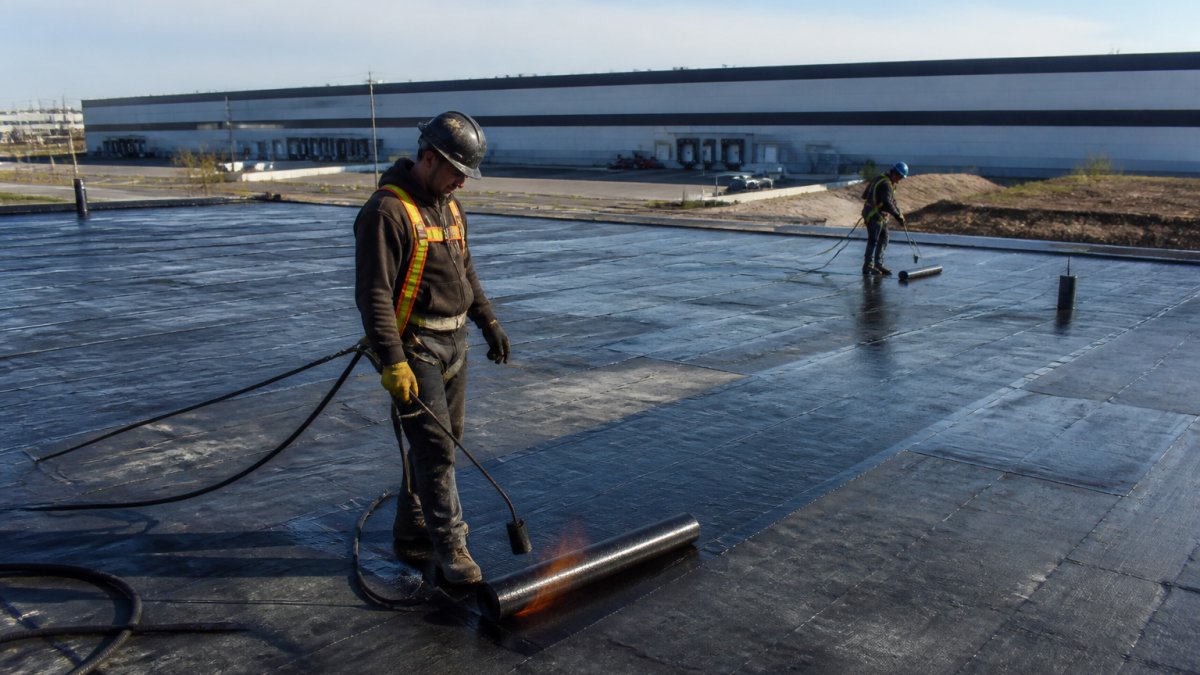
- Torch-on modified bitumen (SBS or APP). Heat-fused layers form a tough, redundant surface. Suits high-traffic roofs, industrial buildings, and roofs with heavy mechanical equipment. Trade-off: open flame requires hot-work permits and fire watch, which complicates occupied buildings.
- Cold-process membrane. Adhesives cure without open flame, so it works on occupied retail plazas and buildings where a hot-work permit would shut down operations. Trade-off: longer cure windows in cold weather, and adhesive quality matters more than on torch-on.
- Standing-seam metal. Not a flat-roof membrane, but common on low-slope commercial buildings with enough pitch. Long service life and good snow shedding. Trade-off: higher upfront cost and more fastener and flashing detail work.
The Layers Under the Membrane Matter More Than the Membrane
Two buildings of the same size can get quotes that differ by tens of thousands of dollars because of what is under the surface:
- Deck condition. Wet or delaminated decking must be replaced before a new membrane goes down. A contractor who quotes without opening the roof is guessing.
- Insulation and R-value. Adding tapered insulation improves drainage and thermal performance, but it adds cost and thickness that can affect curbs, drains, and door thresholds.
- Tapered vs. flat insulation. Tapered systems direct water to drains and reduce ponding, which is the leading cause of premature membrane failure on flat roofs.
How Long a Replacement Takes
Most commercial flat roof replacements run two to six weeks, depending on square footage, deck condition, and weather windows. Occupied buildings can usually stay open throughout if the crew works in sections and maintains a watertight tie-in at the end of each day. Metal roofing on a pitched commercial building often runs longer because of the number of panels and flashing details.
Disruption Control on Occupied Buildings
- Sectional tear-off. The crew removes and replaces one area at a time so the building is never fully exposed.
- Daily watertight tie-in. Every day ends with the open area sealed, not tarped and hoped for.
- Hot-work permits and fire watch. Required for torch-on; the contractor should manage the permit, not you.
- Tenant and parking coordination. Staging, crane placement, and dumpster locations need to be planned before day one.
Ask any contractor how they will keep the building watertight overnight during a replacement, and ask to see the tapered insulation layout drawing. The answers reveal whether they have done this on an occupied site and whether they understand drainage.
Lifecycle Trade-Offs by Building Type
- Warehouse or distribution center: single-ply or standing-seam metal, large panels, minimal penetrations, long service life.
- Retail plaza with tenants: cold-process membrane or single-ply, sectional work, odor and access control.
- Industrial plant with equipment on the roof: torch-on modified bitumen, high puncture resistance, hot-work controls.
- Multi-family or condo: cold-process or single-ply, tenant communication, balcony and vent detailing.
A system that lasts several years longer usually wins even when the initial quote is higher. The right question is not “which membrane is cheapest” but “which assembly fits this building, this use, and this disruption tolerance.”
Commercial Roofing Cost: What Drives Your Quote
Commercial roofing cost is driven by roof area, membrane system, deck and insulation condition, access difficulty, and how much work must happen outside normal hours.
What most guides miss is that the quote is only one line of the total cost. Lifecycle cost includes repairs, maintenance visits, and the year the roof is replaced again. A system that lasts several years longer usually wins even when the initial quote is higher.
How a Commercial Roofing Quote Is Actually Built
A credible quote is a line-item estimate, not a single number. Ask for it broken into:
- Tear-off and disposal. Removing the old membrane and hauling it away, including any hazardous material handling.
- Deck repair allowance. A stated per-square-foot allowance for replacing wet or damaged decking found once the roof is open.
- Insulation and cover board. Material and labor, including tapered insulation if drainage is being corrected.
- Membrane material and installation. Priced by the square (100 square feet), which is the standard unit in the trade.
Repair vs. Replacement: The Decision Threshold
A common pattern is that a roof with isolated defects is a repair, while a roof with widespread saturation, failed seams across multiple areas, or a membrane past its expected service life is a replacement. The practical test:
- One or two leaks, dry insulation: repair.
- Leaks that return after repair, or wet insulation found in multiple areas: replacement is usually cheaper over the next five years.
- Membrane at or past expected service life: replacement, even if it is not leaking yet.
- Storm or hail damage: document it and check whether insurance or the manufacturer warranty applies before authorizing work.
Budgeting a Replacement Reserve
Property owners who avoid January emergencies set aside a reserve rather than waiting for a failure. A practical approach:
- Estimate the current replacement cost per square foot for your roof system and building type.
- Divide that total by the expected service life of the system in years.
- Contribute that amount annually to a dedicated reserve.
- Revisit the estimate every few years as material and labor costs change.
This is the same logic condo corporations use for reserve fund studies, and it applies equally to a single commercial building.
Quote Factors That Change the Number
- Roof area and complexity. More penetrations, curbs, and equipment mean more labor per square.
- Deck and insulation condition. The single biggest source of quote variance.
- Access. A roof reachable by ladder is cheaper than one needing a crane.
- Season. Winter work in Alberta carries weather-delay risk and heating costs for adhesives.
Be wary of any quote that arrives without a site visit. Pricing a commercial roof from satellite imagery is guesswork, and a low bid that excludes deck repair or flashing is not a lower cost, it is a deferred change order.
A quote that is dramatically lower than the others is usually missing scope, not offering a deal. Compare line items, not totals.
Preventive Maintenance and Lifecycle Planning for Edmonton Buildings
Preventive maintenance is the cheapest money you will spend on a roof. A scheduled program of inspections, drain clearing, and prompt seam repair typically extends service life and prevents the small failures that become interior water damage.
A practical lifecycle plan looks like this:
- Year 1-5: annual inspections, drain clearing, warranty compliance
- Year 6-12: semi-annual inspections, targeted repairs, budget accrual for replacement
- Year 13+: condition assessment each fall, replacement planning two to three years out
Set aside a replacement reserve now rather than scrambling when a membrane fails in January.
Skipping fall drain clearing is the most common cause of winter ponding and ice damage on Edmonton flat roofs. Water that cannot drain will freeze, expand, and find every weak seam.
Alberta winters do not forgive a poorly installed roof, and the wrong contractor costs more than the right one ever will.
Frequently Asked Questions
How do I choose a commercial roofing contractor in Edmonton?
Start with a commercial roofing contractor checklist: verify licensing and liability insurance, ask for references on similar commercial buildings, and confirm crews have experience with flat and low-slope systems. Get at least three written quotes that itemize materials, labour, and warranty terms. Ask how they handle tenant coordination and whether they offer 24/7 emergency service. A contractor who answers these clearly and provides documentation is usually the safer choice.
How much does commercial roof replacement cost?
Commercial roofing cost depends on roof size, membrane type, insulation requirements, removal of the old system, and access. Pricing also varies with height, rooftop equipment, and whether work must be staged around tenants. Because these factors differ so much from building to building, most contractors provide a free estimate after a site inspection. Request an itemized quote so you can see exactly what is included and compare bids fairly.
What is included in a commercial roof inspection?
A commercial roof inspection covers the membrane surface, seams, flashing, drains, penetrations, and rooftop equipment supports. The inspector also checks for ponding water, blisters, and signs of moisture in the insulation. You receive a written report with photos and recommended repairs. For flat roofs in Edmonton, inspections are best done in spring and fall to catch freeze-thaw damage before it spreads. Many contractors offer maintenance plans that include regular inspections.
How long does a commercial flat roof replacement take?
Timelines vary with roof size, weather, and system type. A small warehouse roof might take a few days, while a large retail plaza or multi-building complex can take several weeks. Contractors who work around occupied buildings often phase the work to limit disruption. Ask for a start date and completion estimate in writing, and confirm how weather delays are handled. A clear schedule helps you plan operations and tenant communications.