
Table of Contents
- Flat Roof Repair Cost: What You Need to Know
- Factors That Affect Your Flat Roof Repair Cost
- How Long Does Flat Roof Repair Take?
- Flat Roof Leak Repair Cost Breakdown
- Flat Roof Repair vs Replacement Cost
- Getting an Accurate Flat Roof Repair Estimate
- Protecting Your Flat Roof Investment
- Frequently Asked Questions
Last Updated: October 16, 2026
Flat Roof Repair Cost: What You Need to Know
Flat roof repair quotes often vary by thousands of dollars because pricing depends on factors most property managers never think to ask about.
This guide covers what drives flat roof repair cost, what to expect to pay, and how to spot an unrealistic quote.
Flat roof repair cost varies by membrane type, roof size, labour intensity, and whether you’re fixing a localized leak or systemic damage.
Factors That Affect Your Flat Roof Repair Cost
Several variables determine what you’ll pay.
Membrane Type and Material Durability
The membrane, your roof’s waterproof layer, comes in materials with different repair costs and lifespans. Common membrane types include TPO, EPDM, and torch-on asphalt.
TPO is heat-welded, making repairs straightforward but sometimes requiring specialized equipment. EPDM is glued down and more forgiving for patches, though its adhesive degrades in freeze-thaw cycles.
Durability affects cost indirectly: if a membrane is near the end of its lifespan, a repair may be temporary.
Roof Size and Project Scope
A 10-square-foot leak costs far less than one spanning 100 square feet. Larger roofs also bring accessibility challenges, more safety equipment, and bigger crews.
Scope depends on what’s wrong: a single puncture or seam failure is quicker to fix than ponding water or a systemic problem across multiple areas.
Labour, Tear-Off, and Disposal
Labour is often the largest cost component.
Tear-off adds time and cost. If damage reaches the insulation or deck, disposal costs rise with the volume removed, and fees vary by local regulations.
Cold weather slows work: membranes stiffen, adhesives cure slowly, and crews need more breaks. In Alberta’s winter, flat roof repairs take longer than the same job in summer.
How Long Does Flat Roof Repair Take?
Repair time varies by type and conditions.
Cold temperatures slow adhesive curing and stiffen membranes; rain or snow halts work entirely. Spring and fall jobs take longer than summer ones due to temperature swings.
On occupied commercial properties, working around tenants or coordinating with building management stretches calendar time even when actual work hours stay the same.
Flat Roof Leak Repair Cost Breakdown
Leaks are the most common reason property managers call a roofer. This section is repair-only: the figures below reflect fixing an existing flat roof, not replacing it.
Common Repairs and Their Cost Range
Pricing depends on quantity, dates, and delivery. For current prices or a quote, contact Iron Shield Roofing.
| Repair type | Typical scope | Typical cost range (CAD) |
|---|---|---|
| Puncture or small hole patch | Clean, prime, and seal a single opening | $350 – $900 |
| Seam or lap failure repair | Re-prepare and re-weld or re-adhere a failed joint | $500 – $1,500 |
| Flashing repair (wall, curb, vent) | Rebuild or reseal metal or membrane flashing | $600 – $2,000 |
| Drain or scupper repair | Clear, reseal, or replace a roof drain or scupper | $500 – $2,500 |
| Ponding water correction | Add tapered insulation, adjust drainage, or regrade | $1,500 – $6,000+ |
| Localized membrane replacement | Remove and replace a section of membrane | $1,200 – $4,500 |
| Wet insulation removal and replacement | Cut out saturated insulation, replace, and re-cover | $2,000 – $8,000+ |
A puncture patch is the least expensive option. Seam repairs cost more due to careful preparation and re-sealing. Ponding water repairs are more involved: pooling signals drainage problems, so the fix may require tapered insulation, drain repair or replacement, or regrading to address the root cause.
How Membrane Type Changes the Repair Price
Your membrane affects both materials cost and labour time, since each material is joined and repaired differently.
- SBS-modified bitumen (torch-on): Repairs are usually the most labour-intensive because the membrane must be heated and bonded in layers. The upside is that torch-on repairs blend into the existing roof well when done correctly.
- TPO (thermoplastic polyolefin): Heat-welded seams mean repairs are fast and clean when the crew has the right welder. The catch is that a poor weld can fail, so the quality of the technician matters more than the material price.
- EPDM (ethylene propylene diene monomer): Glued or taped repairs are often forgiving for small patches. However, EPDM adhesive can degrade faster in freeze-thaw cycles, so repairs on older EPDM roofs may need to be revisited sooner.
Material compatibility matters: a patch made from a different membrane can fail prematurely, so confirm the existing type before quoting.
What Drives the Price Up or Down
Beyond repair type, several flat-roof-specific factors move the number:
- Roof access: A roof reachable by an interior hatch or a fixed ladder is cheaper to service than one requiring a lift, crane, or swing stage.
- Ponding water and drainage: Standing water signals a drainage problem that may need more than a patch.
- Penetrations and parapets: Every vent, pipe, HVAC curb, and parapet wall is a potential leak path and adds detail work.
- Insulation and decking condition: If water has reached the insulation or deck, the repair grows from a surface patch into a cut-out and rebuild.
- Occupied building constraints: Working around tenants, business hours, or sensitive equipment adds scheduling and protection costs.
- Season: Cold-weather repairs take longer because membranes stiffen and adhesives cure slowly.
Ask the contractor to quote the repair and, separately, the cost to inspect the full roof. A repair-only quote can miss a second leak path that will show up after the next rain.
Leak Diagnosis and Emergency Tarping
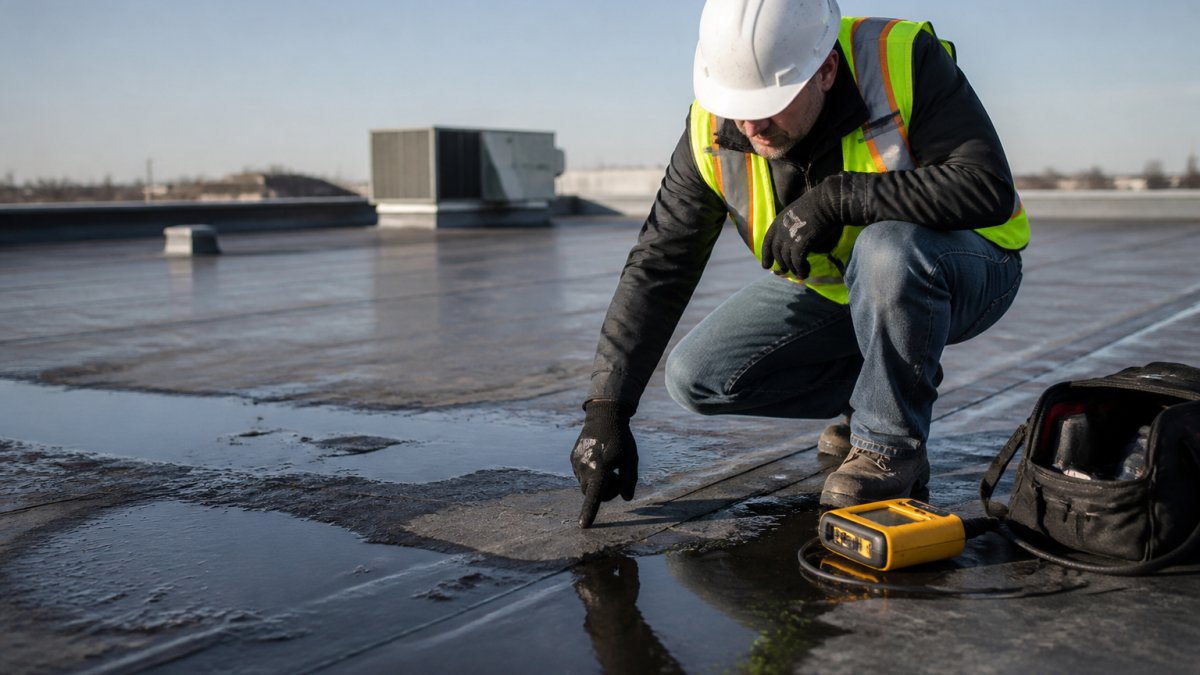
Before any repair, a contractor must find the leak. Water can travel along the deck or insulation before pooling in a visible spot, so diagnosis takes time and sometimes moisture meters or thermal imaging.
Emergency tarping is a temporary fix when a leak needs immediate attention but permanent repair is delayed. It protects the interior until a proper repair can be scheduled, typically costs a few hundred dollars, and is often credited toward the permanent repair if the same contractor does the work.
A tarp is a stopgap, not a repair. Leaving one in place through a freeze-thaw season can trap moisture and make the eventual repair more expensive.
Flat Roof Repair vs Replacement Cost
Repair versus replacement is one of the most important choices a property manager makes. Repair costs less upfront, but replacement is sometimes the better long-term investment.
A Simple Decision Framework
Work through these questions in order; the first “yes” usually points toward replacement.
- How old is the membrane? If a membrane is relatively new and the damage is localized, repair is often the right call. If it is nearing the end of its expected service life, replacement may be more economical because repairs can become recurring.
- How many leaks have you had in the last 24 months? One isolated leak is a repair. Three or more separate leaks in different areas is a pattern that points to a failing roof system.
- Is the damage localized or widespread? A single puncture or seam failure is a repair. Widespread blistering, splitting, or seam failure across multiple areas is a replacement signal.
- Has water reached the insulation or deck? If moisture has saturated the insulation or rotted the decking, the repair scope expands significantly. At that point, the cost gap between repair and replacement narrows.
- How long do you plan to own the building? If you will hold the property for 10+ years, replacement spreads its cost over a longer service life. If you plan to sell within a few years, a well-documented repair may be the better financial move.
- What is the disruption cost? For an occupied commercial building, downtime and tenant complaints have a real cost. A quick repair minimizes disruption. A full replacement takes longer but can solve problems for an extended period.
Repair vs Replacement: Rough Cost Comparison
For a typical flat roof, the numbers usually look like this:
| Scenario | Typical cost range (CAD) | Expected service life |
|---|---|---|
| Single localized repair | $350 – $2,500 | 1 – 5 years, depending on membrane age |
| Multiple repairs over 2-3 years | $3,000 – $10,000 cumulative | Still limited by the underlying membrane |
| Full flat roof replacement (small residential) | $8,000 – $20,000 | 15 – 25 years |
| Full flat roof replacement (commercial) | $15 – $35 per square foot installed | 15 – 25 years |
These are planning ranges, not quotes. Repeated repairs can approach the cost of replacement.
When Repair Is the Right Call
Repair makes sense when the membrane is under 10 years old, damage is localized, and the rest of the roof is sound, especially when the leak source is clear and the scope is bounded, like a failed flashing or single puncture.
When Replacement Is the Better Investment
Replacement is more cost-effective when the membrane is near the end of its lifespan, damage is widespread, or failures keep recurring. It’s also right when insulation or decking is saturated, since surface repairs without fixing the wet substrate just move the problem.
If you are facing a third repair on the same roof in three years, get a replacement quote alongside the repair quote. The comparison often changes the decision.
The Hidden Cost of Deferring Replacement
Deferring replacement isn’t free. Every interior leak risks damage to ceilings, insulation, electrical systems, and tenant property, and can void manufacturer warranties if repairs use incompatible materials or unqualified crews. A repair that buys two years can be right, but as a deliberate decision, not a default.
Getting an Accurate Flat Roof Repair Estimate
A solid estimate confirms you understand the scope and cost. Here’s what it should include and which red flags to watch for.
What to Include in Your Estimate Request
When contacting a contractor, provide as much detail as possible: Is water actively dripping inside? Is the membrane visibly damaged? Are there signs of ponding or poor drainage?
Share the roof size, access details, and any time constraints, such as needing the repair done before winter. A complete estimate should list materials, labour, tear-off and disposal, and equipment rental, and specify what’s included, does it cover only the visible leak or a broader inspection?
Red Flags in Contractor Quotes
A quote significantly lower than others is worth questioning, it may mean corner-cutting, substandard materials, or an underestimated scope.
A vague estimate that doesn’t break down costs makes comparison hard. Labour, materials, and additional fees should be listed separately.
Avoid contractors who pressure you to decide immediately or won’t provide a written estimate. Professionals take time to assess the roof and document their proposal clearly.
Protecting Your Flat Roof Investment
Repairs are necessary, but prevention is cheaper.
Inspect twice a year, spring and fall, for standing water, debris buildup, membrane cracks, and deterioration.
Address small issues immediately.
Document your maintenance.
A flat roof repair doesn’t have to be a guessing game.
At Iron Shield Roofing, we specialize in flat roof repairs engineered for Alberta’s climate.
Frequently Asked Questions
How much does it cost to repair a flat roof?
Flat roof repair costs depend on the extent of damage, membrane type, roof size, and labour requirements. Small leak repairs may cost significantly less than extensive damage requiring membrane replacement. To get an accurate figure for your property, contact a contractor for a site inspection and detailed estimate. Pricing varies based on your specific roof condition and project scope.
What is the difference between flat roof repair and replacement cost?
Repairs address specific damage like leaks or small membrane tears and typically cost less upfront. Replacement involves removing the entire roof system and installing new membrane, which costs substantially more but provides a fresh warranty and longer-term protection. If your roof has recurring leaks, multiple damaged areas, or is nearing end of life, replacement may offer better long-term value despite higher initial cost.
How long does a flat roof repair take?
Simple repairs like patching a single leak may take one to three days, depending on weather and membrane access. Larger repairs affecting multiple areas or requiring membrane sections to be replaced can take one to two weeks. Weather conditions, roof accessibility, and the need to coordinate around building operations can extend timelines. Your contractor should provide a realistic schedule during the estimate phase.
What factors should I ask about when getting a flat roof repair estimate?
Ask about membrane type, the full scope of damage found during inspection, whether tear-off and disposal are included, labour costs, timeline, warranty coverage, and insurance requirements. Request a detailed breakdown separating materials from labour. Verify the contractor’s experience with your specific membrane type (SBS, TPO, EPDM, or asphalt) and ask for references from similar projects. Compare multiple quotes to understand price variations.