Last Updated: October 25, 2026
Quick Summary
To fix recurring roof leaks for good, trace the water backward from the stain to its actual entry point and repair the cause, not the visible damage. Recurring roof leaks usually return because a patch sealed the symptom while failed flashing, cracked boots, lifted seams, or trapped moisture kept feeding the leak.
- Water rarely enters where the stain appears, so trace it backward to the real entry point.
- Never patch until you have seen water enter at that exact spot.
- Durable repairs need compatible materials, proper surface prep, and full coverage past the damage.
- Never seal a leak while water is actively running through it.
- If you have paid for the same leak twice, the third repair should be a diagnosis.
Table of Contents
- Why Does My Roof Keep Leaking After Repair?
- How to Find the Source of a Roof Leak
- Temporary Roof Leak Repair: What to Do Right Now
- Fixing the Most Common Leak Points: Flashing, Shingles, and Penetrations
- Roof Leak Prevention and Maintenance That Actually Works
- When to Repair, Replace, or Call a Professional Roofer
- Documenting Recurring Roof Leaks for Warranty and Insurance Claims
- Book a Free Leak Assessment Before the Next Winter
- Frequently Asked Questions
Why Does My Roof Keep Leaking After Repair?
Most recurring roof leaks come back because the first repair treated the symptom, not the cause. Water rarely enters where the stain appears. It travels along the roof deck, so a patch placed at the visible drip often seals the wrong spot entirely.
Alberta’s freeze-thaw cycles open small gaps, snow load stresses seams, and a quick patch fails by the next spring melt.
The Patch-and-Pray Problem
A tube of roofing cement and a square of membrane feel like a fix. They aren’t.
The patch seals the surface, but the underlying problem stays hidden. Common culprits include:
- A failed seal under a flashing flange
- A hairline crack that grows with each freeze
- Water trapped in the roof deck or insulation
Each of these keeps feeding the leak. The patch holds for a season, then fails again. That’s the cycle you’re stuck in.
Material Compatibility and Repair Durability
Repair durability depends on matching materials. A cold-process patch over a torch-on membrane can bond poorly at the edges. Sealant that doesn’t flex with the roof will crack the first time temperatures swing below freezing.
Durable repairs share three traits:
- Compatible materials. The patch matches the existing membrane and its movement.
- Proper surface prep. Clean, dry, primed edges let the repair bond fully.
- Full coverage. The repair extends past the damage, not just over it.
Skip any of these and the repair is temporary, whether or not anyone says so.
How to Find the Source of a Roof Leak
Finding the source means tracing water backward from the stain to the actual entry point. That point is often several feet uphill on the roof.
Work through this in order:
- Start inside. Note the stain’s location and check the attic or ceiling above it.
- Follow the deck. Look for water tracks, dark streaks, or wet insulation along the roof deck.
- Check the usual suspects. Flashing, penetrations, valleys, and seams are the most common entry points.
- Test with water. A helper runs a hose at low flow while you watch from inside.
- Confirm before sealing. Never patch until you’ve seen water enter at that exact spot.
A Systematic Leak-Tracing Workflow
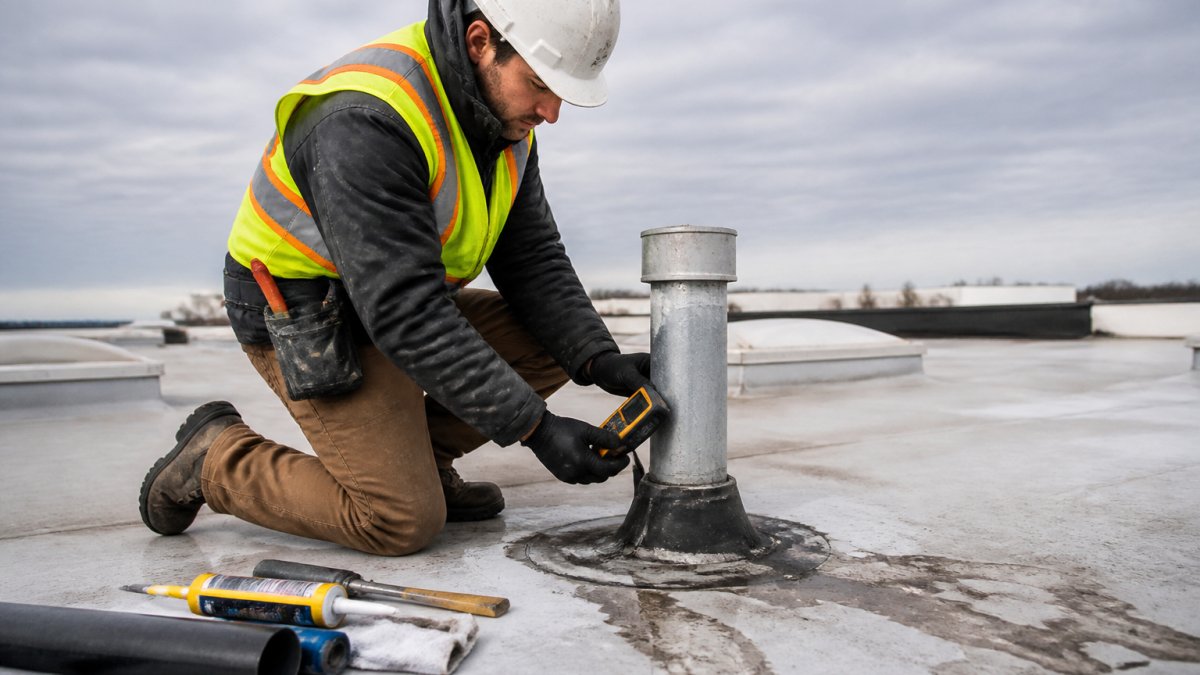
A repeatable workflow beats guesswork. Here’s the approach we use:
- Document first. Photograph the stain, note the date, and log the weather when it leaks.
- Map the water path. Sketch the roof and mark every penetration, seam, and drain.
- Isolate sections. Divide the roof into zones and test one at a time.
If the leak resists tracing, a professional roof inspection can find the entry point with moisture readings and a full roof assessment.
Temporary Roof Leak Repair: What to Do Right Now
Stop the water first, then fix it properly. Temporary repairs buy time, not a solution.
Do this now:
- Contain the water. Buckets under drips, towels along the path, plastic sheeting over furniture.
- Relieve the pressure. If water is pooling in a ceiling bulge, pierce it with a small hole over a bucket.
- Clear the drains. Remove debris from gutters, scuppers, and roof drains.
- Apply a temporary seal. Use compatible sealant or a peel-and-stick patch on a dry surface if conditions allow.
- Stay off the roof in bad weather. Wet, icy, or snow-covered roofs are not safe to walk.
Watch out: Never seal a leak while water is actively running through it. Trapped moisture rots the deck and insulation, and the repair will fail.
Fixing the Most Common Leak Points: Flashing, Shingles, and Penetrations
Most recurring leaks start at the same handful of spots. Fix these correctly and you break the cycle. The key is to repair the mechanism, not just the visible damage, a surface patch over a failed flashing flange or a lifted seam will fail again at the next freeze-thaw swing.
Flashing: Where Most Recurring Leaks Begin
Flashing fails in three predictable ways: the sealant under the flange dries and cracks, the metal lifts from the roof surface as the building moves, or fasteners back out and leave open holes. On chimneys, walls, and skylights, look for gaps where the metal no longer sits flush and for cracked or missing sealant along the top edge.
A durable flashing repair means lifting the existing metal, cleaning and priming the substrate, reseating the flange, and re-fastening with compatible screws before sealing the edges. Simply smearing sealant over the top of failed flashing traps water behind the metal and guarantees a repeat leak.
Shingles: Replace, Don’t Just Reseal
Cracked, curled, or missing shingles let water past the surface and into the underlayment. Resealing a lifted shingle tab with roofing cement is a temporary measure at best; the adhesive rarely survives a full temperature cycle.
On sloped roofs, shingle damage often clusters near valleys and penetrations, where water volume and wind exposure are highest. If you find repeated failures in the same area, the underlayment or deck beneath may already be compromised.
Penetrations: Collars, Boots, and Fasteners
Vents, pipes, and fasteners are the most common entry points on both flat and sloped roofs. Pipe boots crack at the collar as the rubber ages; vent flanges lift; fasteners back out and leave unsealed holes. Replace cracked boots rather than sealing over them, reseat vent flanges with compatible sealant, and re-seal every exposed fastener with a product rated for the membrane type.
Valleys and Seams
Valleys concentrate water flow, so any debris or lining damage there shows up as a leak quickly. Clear debris and confirm the valley lining is intact before resealing. On flat roofs, lifted membrane seams should be re-rolled or re-welded, not topped with sealant, because a surface bead will not restore the seam’s bond.
Never seal over wet or actively leaking components. Trapped moisture rots the deck and insulation and causes the repair to fail from underneath.
For sloped roofs with flashing and shingle damage, our sloped roof repair service handles these fixes with materials matched to your existing roof.
Roof Leak Prevention and Maintenance That Actually Works
Prevention is cheaper than repair. A simple routine catches small problems before they become leaks.
- Inspect twice a year. Check in spring after the melt and in fall before snow.
- Clear debris. Remove leaves, branches, and grit from drains and valleys.
- Trim overhanging branches. Keep trees back from the roof surface.
A sloped roof maintenance program keeps this on schedule, so nothing gets missed between seasons.
When to Repair, Replace, or Call a Professional Roofer
Repair makes sense when the damage is isolated and the roof has life left. Replace when leaks keep returning across multiple areas, the deck is soft, or the roof is near the end of its service life. For recurring leaks specifically, the decision hinges on whether the failures share a cause or point to a roof that is failing systemically.
Repair Indicators
- The leak traces to a single component, one flashing detail, one penetration, one seam, and the surrounding roof is sound.
- The deck and insulation are dry or can be dried after the repair.
- The roof is well within its expected service life for its material and climate exposure.
Replacement Indicators
- Leaks return in different locations after each repair, suggesting widespread membrane or flashing failure rather than isolated damage.
- The roof deck is soft, spongy, or visibly deteriorated, a sign that water has been trapped for multiple seasons.
- The roof is near or past its expected service life and repairs are becoming annual.
When to Call a Professional
Call a professional when:
- The leak returns after two repairs
- You can’t find the entry point
- The roof deck or insulation is wet
A professional assessment should include moisture readings, a deck condition check, and a written opinion on repair versus replacement, not just a quote for another patch.
If you have paid for the same leak twice, stop patching. The third repair should be a diagnosis, not another sealant application.
If you’re ready to hand it to a crew, review our professional roof repair services to see what a proper repair covers.
Use these indicators to decide whether the roof needs a repair, a replacement, or a professional assessment.
| Decision | Indicators |
|---|---|
| Repair | Leak traces to a single component and surrounding roof is sound |
| Repair | Deck and insulation are dry or can be dried after repair |
| Repair | Roof is well within its expected service life |
| Repair | Previous repairs failed due to material incompatibility or poor prep |
| Replace | Leaks return in different locations after each repair |
| Replace | Roof deck is soft, spongy, or visibly deteriorated |
| Replace | Roof is near or past service life and repairs are annual |
| Call a professional | Leak returns after two repairs, or entry point can’t be found |
Documenting Recurring Roof Leaks for Warranty and Insurance Claims
A paper trail protects you. Insurers and warranty providers want proof the leak is a recurring problem, not a one-off.
Keep these records:
- Photos of the stain and roof damage, dated
- Receipts and reports from every repair
- Notes on weather when each leak appeared
Many warranty claims fail because owners can’t show a documented history. Log every leak from day one.
Book a Free Leak Assessment Before the Next Winter
Recurring leaks rarely fix themselves. Each freeze-thaw cycle widens the gap, and another winter makes it worse. The smart move is to find the real source now, before the snow arrives.
Iron Shield Roofing specializes in flat, low-slope, and metal roofing built for Alberta’s climate.
Get started with Iron Shield Roofing and book a free leak assessment before the next winter.
Frequently Asked Questions
Why is my roof still leaking even after it has been repaired?
The most common reason is that the previous repair addressed the visible water stain rather than the actual entry point. Water travels along the roof deck, insulation, or framing before it shows up indoors, so a ceiling stain can sit metres away from the failed flashing or seam. A second cause is incompatible materials: roofing cement applied over a wet or dirty surface, or a sealant that cannot flex through freeze-thaw cycles, will fail within a season. Proper diagnosis, not another patch, is what stops recurring roof leaks.
How can you find the source of a recurring roof leak?
Start indoors and work outward. Note the stain location, then trace upward and across to the nearest roof feature: chimney, vent, skylight, valley, or wall junction. On the roof, check those features first for flashing gaps, lifted seams, or cracked sealant. A systematic leak-tracing workflow also uses a hose test on a dry day, starting low and working uphill, plus an attic inspection for wet decking, insulation staining, and daylight. Documenting each finding helps a professional roofer confirm the entry point faster.
Can a roof leak be repaired without replacing the roof?
In many cases, yes. Isolated failures at flashing, penetrations, or a handful of shingles can be repaired without a full replacement, provided the surrounding roofing material is still sound. The decision usually turns on the age of the roof, how widespread the water intrusion is, and whether the decking or insulation has suffered moisture damage. A repair estimate should state clearly what is being fixed and why; if a roofer recommends replacement, ask for the specific evidence, such as saturated insulation or multiple failed seams.
How long can you leave a leaking roof before repairing it?
Treat any active leak as urgent. Even a slow drip can saturate insulation, stain ceilings, and create conditions for mold within days to weeks, and in colder months water can refreeze and widen cracks. Temporary roof leak repair, such as a tarp or a properly applied sealant, buys time but is not a fix. Leaving a leak through a winter risks ice damming, interior moisture damage, and higher repair costs. Book a professional assessment as soon as the leak appears.

